When Gratitude and Grief Show Up Together at Thanksgiving

You can feel grateful at Thanksgiving and still grieve. Enjoying a meal, a conversation, or a moment of laughter does not mean your loss matters less. Missing someone does not mean you have failed to appreciate the people who are here. Gratitude and grief can show up together because they respond to different truths about your life.
If Thanksgiving feels harder than you expected, start by letting both feelings exist without asking either one to win. Then decide what kind of day you can actually manage: which gathering, if any, feels right; how you want to acknowledge your loss; and who can support you if emotions rise. At ATX Trauma & Grief Therapy, we approach holiday grief as part of a person's whole story, not as a feeling to overcome before they can participate in life.
The goal is not to make Thanksgiving painless. It is to make room for what is true, whether that means joining dinner, leaving early, changing a tradition, or spending the day quietly. You do not owe anyone a performance of thankfulness.
What does it mean to feel gratitude and grief at the same time?
Grief is a response to losing someone or something meaningful. That loss may be a death, but it may also be a relationship, a sense of safety, a family connection, a hoped-for future, or a version of yourself that no longer fits your life. Gratitude is an appreciation of something meaningful in the present. The two feelings are not opposites.
Imagine noticing that a friend saved you a seat at Thanksgiving dinner while also wishing your mother were sitting beside you. Your appreciation for your friend is real. So is the ache for your mother. One does not correct or cancel the other.
Sometimes the feelings arrive one after the other rather than together. You might enjoy the meal and become tearful while driving home. You might wake up sad, feel steady during a walk, then feel sad again when you see a familiar recipe. None of those shifts is a verdict on how well you are healing.
It can help to replace a question like, “Why am I sad when I have so much to be thankful for?” with, “What am I missing, and what feels supportive right now?” The first question puts your emotions on trial. The second gives you information you can use.
Why Thanksgiving can make a loss feel more present
Thanksgiving tends to repeat itself in recognizable ways. The same foods appear. People sit in familiar places. Someone tells a story they have told for years. Those details can bring back memories, including the painful realization that something has changed.
An empty chair may be the obvious reminder, but grief can also show up in less visible ways:
- Changed roles: You are making the meal someone else used to make, or managing a gathering they used to hold together.
- Changed relationships: A breakup, estrangement, or family conflict has altered who you see and how comfortable you feel.
- Changed identity: You are trying to understand who you are after a loss or a difficult period in your life.
- Pressure to act happy: A group gratitude ritual may feel uncomfortable when you are already working hard to get through the day.
- Unexpected reminders: A smell, song, photograph, or comment brings up a memory before you have time to prepare.
There is also the work surrounding the holiday. Travel, cooking, hosting, and explaining your plans can demand energy when you have little to spare. If the season has been difficult before, you may begin dreading it well in advance. Our article on why grief can feel heavier when the seasons change explores why certain times of year can bring a loss back into focus.
Thanksgiving grief is not always about wanting a former holiday back exactly as it was. You may miss a person and also remember that past gatherings were complicated. You may feel relief that a painful relationship has ended and still grieve what you wanted it to become. Mixed feelings deserve space too.

A way to plan for Thanksgiving when you are grieving
At ATX Trauma & Grief Therapy, we encourage a plan built around three questions: What am I carrying? What can I choose? Who can help? It is not a test you have to pass. It is a way to make decisions before the holiday starts making them for you.
1. Name the loss without explaining it away
Try to say plainly what feels painful: “I miss my sister's voice at the table,” or “I am grieving the relationship I hoped my family and I could have.” If several things hurt, name them separately. Grief for a person may sit alongside exhaustion from organizing the meal or anxiety about seeing a relative.
This step matters because different needs call for different responses. Missing someone might lead you to set aside time for a memory. Anxiety about a family member might call for a boundary. Exhaustion might mean reducing your plans. You do not have to solve every feeling to take it seriously.
2. Choose the parts of the holiday that are yours to choose
Before accepting an invitation, ask yourself what you want from the day and what it may cost you. You can choose to attend the whole gathering, arrive for dessert, visit a friend instead, host a smaller meal, or stay home. You can keep a tradition, change it, or let it rest this year.
Consider practical details, not just the invitation itself. How will you get there? Could you leave when you need to? Is there a quiet place to step away? Are there topics you know will be difficult? A plan is easier to follow when it accounts for those details.
If you are unsure, make a flexible commitment: “I would like to come for dinner, but I may need to leave early.” You do not have to promise more than you can give to avoid disappointing someone.
3. Identify support before the day gets difficult
Choose a person who can respond with care rather than trying to make the sadness disappear. Tell them what would be useful. You might want a check-in before dinner, company on a walk, help changing the subject, or a text afterward. You can also ask for practical help with a task that feels overwhelming.
If no one at the gathering feels safe to talk to, your support person does not have to be there. A friend elsewhere can be the person you message when you step outside. What matters is that you know whom you want to contact and what you would like to ask for.
How to make room for your loss during the day
You do not have to choose between hiding your grief and making the entire gathering about it. A small, deliberate act can acknowledge what is missing while respecting your need for privacy.
- Keep a familiar tradition: Make a favorite dish or use a recipe that reminds you of the person you miss. If preparing it feels too painful, let someone else make it or skip it.
- Share a memory: Ask someone willing to listen, “Can I tell you a story about them?” You can also invite others to share, but only if that feels welcome.
- Create a private moment: Look at a photograph, write a few lines in a journal, or take a walk before the gathering.
- Change the tradition: If the old routine leaves you bracing for pain, try a different meal, location, or way of spending the day.
Choose something because it feels meaningful to you, not because anyone says a grieving person should do it. Even a well-intended remembrance can feel like too much. You are allowed to decline a public tribute, and you are allowed to change your mind about participating.
Grief after a breakup or estrangement may need a different kind of acknowledgment. You might be mourning a Thanksgiving you imagined having with someone or the family relationship you hoped would improve. You can write about that hoped-for future privately without needing to explain it to everyone at dinner.
What to say when someone asks you to be grateful
Comments such as “At least you have other people around you” or “Try to focus on the positive” may be intended as comfort. They can still leave you feeling unheard. You are not required to debate your feelings or teach anyone how grief works in the middle of a gathering.
A short response is often enough:
- “I am grateful for the people here, and I miss them.”
- “I am having a hard day. I do not need to look for a bright side right now.”
- “Thank you for caring. What would help is listening.”
- “I would rather not talk about this at the table.”
- “I am going to take a break and come back if I am ready.”
If someone wants everyone to name something they are thankful for, you can offer something small and true, or pass. Appreciation does not have to be grand or public. Being thankful for a friend's message is enough. So is not wanting to take part in the exercise.
Try not to use gratitude as a bargaining tool with yourself: “I noticed one good thing, so I should stop crying.” Instead, let a good moment be a good moment. Let the sadness have its own place. You do not have to measure one against the other.
When Thanksgiving involves difficult family dynamics
Some people are grieving someone who died. Others are grieving the family connection they never had, or the closeness they lost after setting necessary limits. Holidays can sharpen that pain because they often come with expectations about who should gather and how everyone should behave.
If you expect criticism, intrusive questions, or pressure to reconnect with someone who has hurt you, decide what you will do before the conversation begins. You might say, “I am not discussing my relationship today,” then move to another room if the person continues. A boundary includes both what you say and what you can do to protect it.
Consider whether you can arrange your own transportation, limit the length of your visit, or spend time with people who respect your choices. You do not have to attend a gathering that feels unsafe to prove you care about your family. If you do attend, you can still leave.
It is also possible to enjoy parts of a complicated gathering. Laughing with one relative does not erase harm from another. Feeling sad about estrangement does not mean you need to abandon a boundary. For more on planning around difficult interactions, read how to protect your peace when holiday family gatherings feel triggering.
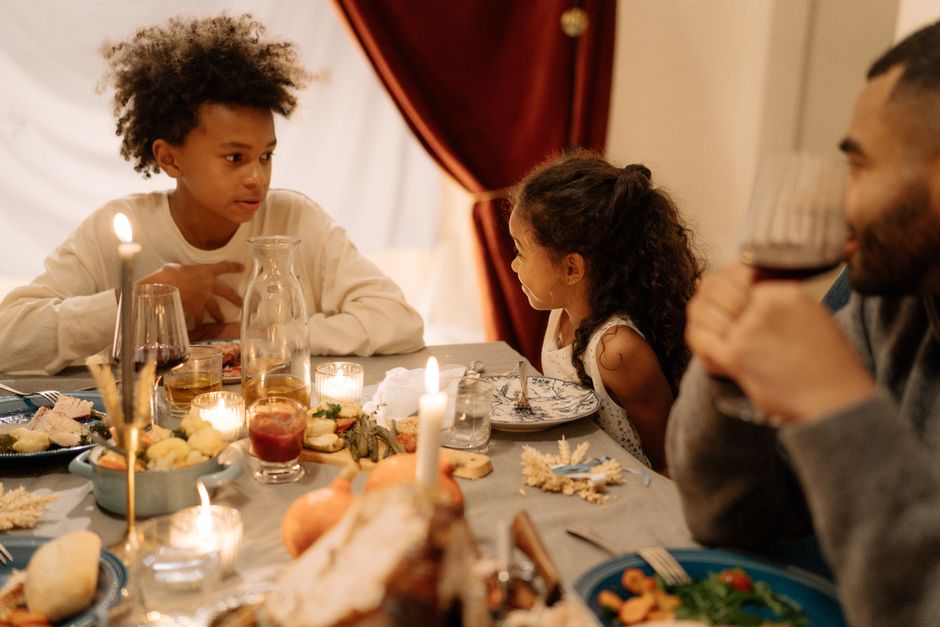
What to do when grief hits at the table
You may prepare thoughtfully and still be caught off guard. A familiar laugh, someone's place at the table, or a question you did not expect can make it suddenly hard to follow the conversation. You do not need to explain yourself before taking care of what you need.
- Pause and notice what is happening. You might silently say, “That memory hurts,” or “I need a moment.” Naming the experience can be easier than arguing with it.
- Give yourself a change of setting. Step outside, get a glass of water, or go somewhere quieter. You can tell a trusted person where you are going if that feels helpful.
- Reconnect with something in the present. Notice your feet on the floor, the chair beneath you, or something you can see in the room. If focusing on your body feels uncomfortable, look around and name a few ordinary objects instead.
- Decide on your next step. You may return to the table, stay away a little longer, call someone, or go home. You do not have to decide what the rest of the holiday means while you are upset.
These steps are not meant to switch grief off. They give you choices when a feeling arrives more intensely than expected. If you find that holiday reminders also bring up a sense of disconnection or numbness, our article on why trauma can make you feel disconnected from your body may help you put words to that experience.
Plan for the hours after Thanksgiving, too
Getting through a gathering is not the whole story. You might feel relatively steady while you are with people and sad once you are alone. You may also feel relieved that it is over. Neither reaction means you made the wrong choice about attending.
Before the day begins, think about what you would like to come home to. That might be an easy meal, a quiet evening, a familiar show, a phone call, or no plans at all. If you are hosting, ask someone else to handle part of the cleanup. If you are traveling, consider whether you need some time to yourself before your next commitment.
Give yourself permission to revise your plans next time. Ask: Which parts of the day felt supportive? Which parts asked too much of me? Was there a person I felt comfortable with? These are practical questions, not a demand to grade your grief. They can help you shape future holidays around your needs rather than repeating a difficult day by default.
When extra support could help
A hard Thanksgiving does not, by itself, mean something is wrong. Grief can be painful, and holidays can make it more noticeable. Support may be especially useful if you are struggling to manage everyday responsibilities, feeling increasingly isolated, or finding that reminders of the loss bring up intense fear, numbness, or painful memories.
You do not need to wait until a particular milestone after a loss to talk with someone. Therapy can offer a place to explore what Thanksgiving brings up, including the loss itself, the family dynamics surrounding it, and the changes in how you see yourself. Our article on what happens in grief therapy when you feel stuck after a loss explains more about that work.
Brittany Burke, LPC-A, works with grief, trauma, attachment wounds, and relationship patterns through virtual therapy across Texas. Her approach at ATX Trauma & Grief Therapy draws on EMDR, parts work, and attention to the broader story behind what you are experiencing, at your pace. If a loss feels traumatic, you can also read about EMDR and traumatic loss. Brittany is supervised by Stephanie Cruz-Trevino, MA, LPC-S.
If you are in immediate danger or thinking about harming yourself, seek immediate support by calling or texting 988 in the United States, or call 911 for an emergency.
Frequently asked questions about grief and gratitude at Thanksgiving
Is it normal to cry on Thanksgiving even if I enjoy parts of it?
Yes. Enjoyment and sadness can occur on the same day. A good conversation does not remove your loss, and tears do not erase the good conversation. You can respond to each feeling as it comes without deciding which one is the “real” one.
Do I have to say what I am thankful for if my family goes around the table?
No. You can share something small and sincere, say you would rather listen, or step away if the moment feels too difficult. You do not have to make a public statement about gratitude to participate in a meal.
What if I do not want to celebrate Thanksgiving at all?
You can choose not to celebrate. For some people, a quiet day feels more manageable than following a familiar tradition. If you feel uncertain, consider what would make the day more bearable, whether that is seeing one trusted person, changing your routine, or leaving your schedule open.
How can I support someone who is grieving at Thanksgiving?
Ask what they would prefer rather than assuming they want to talk or be distracted. You might say, “Would you like us to mention them today?” or “Would it help if I checked in with you after dinner?” Follow their lead, respect a change of mind, and avoid treating a moment of laughter as proof that they are no longer hurting.
Does grief over a breakup or estrangement count as holiday grief?
Yes. Thanksgiving can bring up the absence of a partner, a changed family structure, or the relationship you hoped to have with someone. You do not need a death in the family for a holiday to highlight loss. Your response may include sadness, relief, anger, or more than one of those feelings.
When should I consider grief therapy?
Consider it when you want support understanding your loss, navigating difficult reminders, or making sense of how grief is affecting your relationships and daily life. You do not have to reach a breaking point to ask for help. If you are deciding what kind of support fits, our guide to grief counseling and support groups can help you think through the differences.
You can make a different kind of Thanksgiving
There is no rule that says you must feel grateful all day, keep every tradition, or stay at a gathering longer than you can manage. You can miss someone and welcome a moment of connection. You can be thankful for what is here while grieving what is not. Let those truths sit side by side, and make choices that reflect what you need now.
If you would like support with grief, trauma, or the relationships that make holidays difficult, ATX Trauma & Grief Therapy's virtual therapy across Texas offers a place to work through it at your own pace. To ask about a free 15-minute consultation, email brittany@atxtraumagrieftherapy.com.